
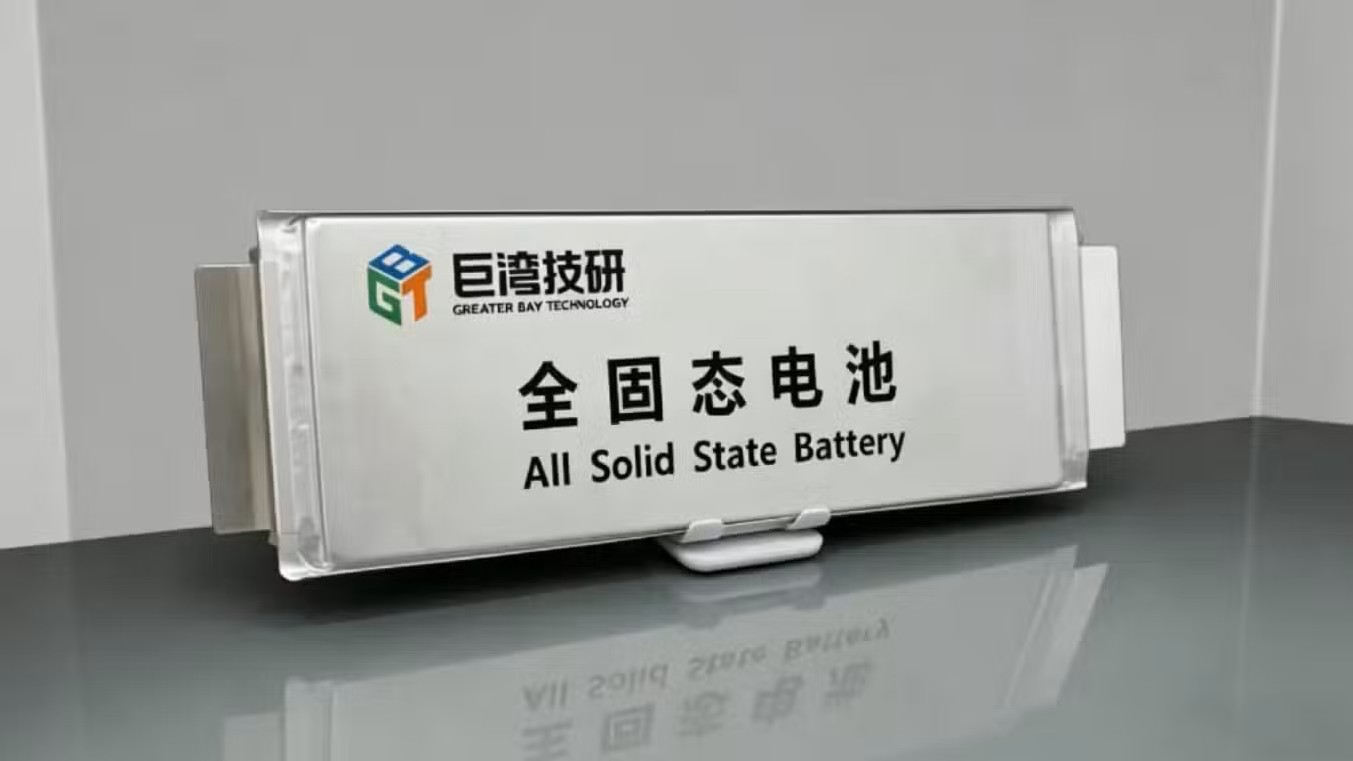
Greater Bay Technology, a company supported by GAC Group, has announced the successful completion of its first A-sample all-solid-state battery cells, marking a pivotal advancement toward the mass production of next-generation power sources. The Guangzhou-based firm stated that its composite electrolyte design has progressed seamlessly from laboratory research to pilot-scale manufacturing, establishing a foundation for high-volume output.
The newly developed cells completely eliminate liquid electrolytes and have successfully endured nail penetration, crush, and thermal-shock testing without exhibiting fire or explosion, thereby mitigating the thermal runaway hazards commonly associated with conventional lithium-ion architectures. According to company figures, energy densities range from 260 Wh/kg to as high as 500 Wh/kg—substantially exceeding those of most commercial liquid-electrolyte packs—while also supporting rapid charging rates between 2C and 3C. This capability potentially removes a primary obstacle to the broader commercialization of solid-state battery technology.
Greater Bay’s proprietary deep eutectic-based composite electrolyte system incorporates multiple materials to improve both ionic conductivity and mechanical stability. This methodology is engineered to strike a balance among performance metrics, production yield, and overall cost, setting it apart from semi-solid or quasi-solid-state alternatives. The company reports that at its Nansha facility in Guangzhou, production yields and cell consistency already meet the rigorous standards required by the automotive industry.
With over 50 patent applications submitted across domains including electrolyte formulation and cell manufacturing processes, Greater Bay is positioning itself to transition from pilot operations to gigawatt-hour-scale production in 2026. This timeline aligns with broader industry expectations for solid-state battery deployment between 2026 and 2027. The company intends to integrate these cells into electric vehicle prototypes for testing later this year.
On the global stage, solid-state battery development continues to diverge across various material approaches—including sulfide, oxide, and polymer systems—each grappling with persistent challenges in ionic conductivity and manufacturing complexity. In the domestic market, data from the China Automotive Battery Innovation Alliance indicated that Greater Bay achieved an installed capacity of 0.21 GWh in March, capturing a 0.37% share of the national battery market and ranking 15th overall.
Next:Hithium and Navarre Sign Investment Agreement for Battery Plant in Spain
Previous:Tesla Expands Supply Chain with Sunwoda as Fifth Global Battery Supplier
Contact Person: Miss. Kiki
| WhatsApp : | +8617763224709 |
|---|---|
| Skype : | +8617763224709 |
| WeChat : | +8617763224709 |
| Email : | kiki@lifepo4-battery.com |
