


Electric vehicle (EV) chargers are essential devices that convert electrical power into a suitable form to recharge the vehicle's battery, playing a critical role in keeping EVs operational. This article examines the distinctions between two main types: on-board chargers and off-board chargers, focusing on their installation, power delivery, and internal components.
On-Board Charger
An on-board charger is a compact unit installed directly within the electric vehicle. Due to space and weight limitations of the vehicle, it is designed to be small, lightweight, and relatively low in power. This built-in design supports convenient charging wherever an outlet is available, though it often comes at the expense of charging speed.
Off-Board Charger
In contrast, an off-board charger is situated externally—typically at dedicated charging stations. Free from the size and weight constraints of a vehicle, it can be larger, more powerful, and capable of delivering energy much faster. Its stationary design supports high-power charging for reduced waiting times.
On-Board Charger
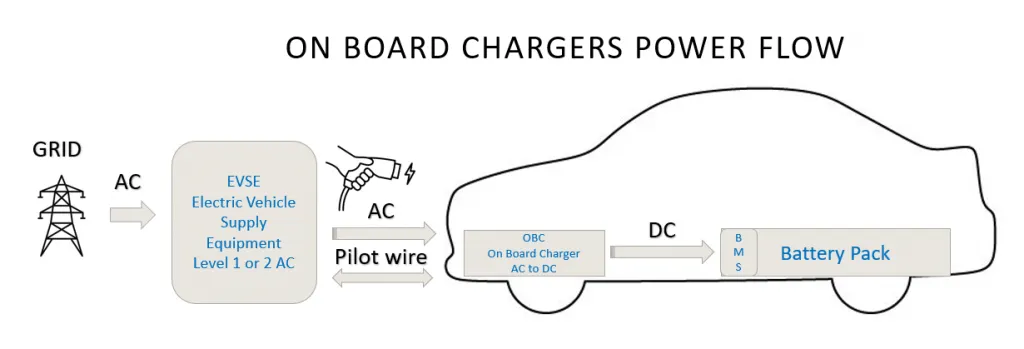
The on-board charger is usually plugged into a standard AC outlet (single-phase 220V or three-phase 380V) via a cable. It converts alternating current (AC) into direct current (DC) to charge the battery. Often termed a “slow charger,” it operates at lower currents, resulting in longer charging durations.
Advantages:
- High convenience—can be used anywhere with an AC socket.
- Gentle on the battery, helping to prolong battery life over time.
Disadvantages:
- Limited power leads to slower charging.
- Constrained by vehicle design, so it cannot match the power output of external chargers.
Off-Board Charger
Connected directly to the AC grid, off-board chargers convert AC to DC externally and deliver high current directly to the battery. These are commonly known as “fast chargers” and are found at DC charging stations.
Advantages:
- High power and current enable significantly faster charging.
- Ideal for quick top-ups, especially during longer trips.
Disadvantages:
- Requires substantial infrastructure investment and is not portable.
- Frequent use may accelerate battery degradation. It is often advised to use fast charging sparingly, prioritizing slower charging for daily needs.
On-Board Charger
It primarily consists of:
- Power Circuit: Includes an AC voltage regulator, transformer, and power transistors to convert AC to DC.
- Control Circuit: Communicates with the vehicle’s Battery Management System (BMS) and adjusts voltage/current according to the battery’s state.
Off-Board Charger
As a more complex system, it typically incorporates:
- Power Unit: Converts AC to DC.
- Control Unit: Manages the charging process.
- Metering Unit: Tracks energy consumption for billing.
- Charging Interface: Connects to the EV’s charging port.
- Power Supply Interface: Links to the electrical grid.
- Human-Machine Interface (HMI): Allows user interaction via a display, touchscreen, or mobile app.
Both on-board and off-board chargers are vital to EV operation. On-board chargers offer portability and ease of use, supporting everyday charging with minimal impact on battery health. Off-board chargers provide rapid, high-power replenishment—ideal for en-route charging—though they come with higher infrastructure costs and potential trade-offs for battery longevity. Understanding these differences helps in selecting the right charging solution, whether for personal use or commercial charging networks.
Next:EVE Energy Debuts CCS-Certified Marine Battery Safety Systems at Marintec China 2025
Previous:CALB Unveils New “Zhiyuan” Marine Battery Series at Marintec China 2025
Contact Person: Miss. Kiki
| WhatsApp : | +8617763224709 |
|---|---|
| Skype : | +8617763224709 |
| WeChat : | +8617763224709 |
| Email : | kiki@lifepo4-battery.com |
