
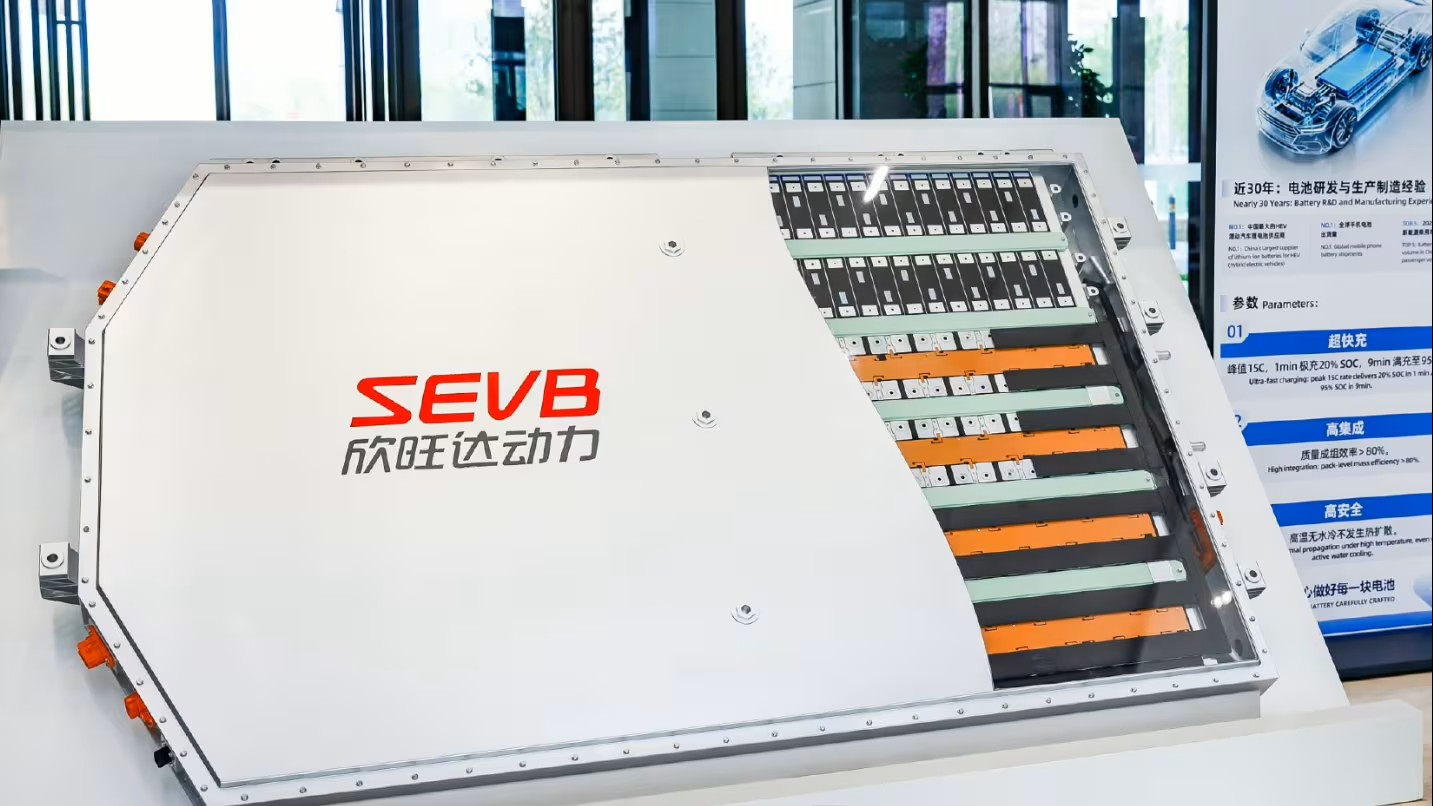
Sunwoda EVB has thrown its hat into China’s increasingly crowded ultrafast-charging arena. The company introduced a 15C intelligent flash-charging battery system and set a goal of deploying 10,000 megawatt-scale charging stations by the end of 2027.
The plan was disclosed on Sept 17. The battery system was first shown at an industry gathering focused on batteries, held Sept 16–17 in Zaozhuang, Shandong province.
Its arrival underscores how aggressively Chinese carmakers and battery suppliers are pursuing flash charging. BYD set the pace in March by launching its second-generation Blade Battery and new flash chargers; since then, Hongqi, Dongfeng and Xpeng have each reported gains in either battery technology or ultrafast-charging infrastructure.
At the conference, Sunwoda shared performance data. At normal room temperature, the battery can go from a 10% state of charge to 70% in five minutes, and reach 97% in nine minutes. Just one minute of charging is enough to add 100 kilometers of driving range.
Those two charging intervals are identical to the room-temperature numbers BYD quoted in March when it introduced the second-generation Blade Battery.
In cold conditions of minus 20°C, Sunwoda says the system needs 15 minutes to go from 10% to 97%. The company also claims the battery can enable more than 700 kilometers of range.
To counter worries that repeated high-power charging can degrade batteries, Sunwoda says the system satisfies a warranty of 10 years or 300,000 kilometers. For vehicles not used in commercial service, there is no cap on ultrafast-charging sessions.
Sunwoda also emphasized intelligence in monitoring. The system combines third-generation smart battery cells, an energy-domain controller and an AI-powered cloud control platform, with the aim of strengthening battery oversight and catching faults earlier.
According to the company, it can issue alerts for more than 20 fault categories between two and 10 days before they occur, with 99.77% accuracy.
Alongside the battery system, Sunwoda introduced an open ecosystem platform that links solar power, energy storage and flash charging, pushing the company further into charging infrastructure.
This platform brings together flash-charging EV batteries, energy-storage systems, megawatt charging units, high-power liquid-cooled charging terminals and an AI cloud-control platform. It is designed to serve vehicles from different brands and to accommodate various partnership structures.
Sunwoda aims for its flash-charging ecosystem to encompass 10,000 megawatt charging stations by the end of 2027. The announcement did not say where the stations would be built, how much would be invested, which models would use the new battery first, or when mass production would begin.
In China’s flash-charging sector, the contest has moved beyond unveiling technology and into building networks. BYD said on Aug 28 that its 10,000th flash-charging station in China had been completed, and repeated its goal of reaching 20,000 stations by the end of 2026.
Rivals are pressing ahead as well. Hongqi said in July that a battery it developed with China Automotive New Energy Battery Technology (CNET) charged from 10% to 70% in three minutes and 41 seconds at 25°C in tests. It did not provide a mass-production timeline at the time.
Dongfeng presented a prototype of its in-house ultrafast charger on July 29. The unit’s peak output of 1,500 kW per charging connector is on par with BYD’s new flash charger shown in March.
Xpeng said on Sept 15 that its first X-Energy megawatt charging station had started operating in Hong Kong. Built with Halo, a local charging provider, the station welcomes drivers of any vehicle brand.
It has a peak output of 1 megawatt and includes 400 kWh of energy storage. That 1-MW figure refers to the station’s capacity; how quickly a vehicle actually charges still depends on that vehicle’s battery and charging ability.
Welcome to contact us:
Inquire more product details from the: On-Board Charger Suppliers
WhatsApp/Wechat/Skype/Mobile: +8617763224709
Email: kiki@lifepo4-battery.com
Website: www.evlithiumcharger.com
Contact Person: Miss. Kiki
| WhatsApp : | +8617763224709 |
|---|---|
| Skype : | +8617763224709 |
| WeChat : | +8617763224709 |
| Email : | kiki@lifepo4-battery.com |
