
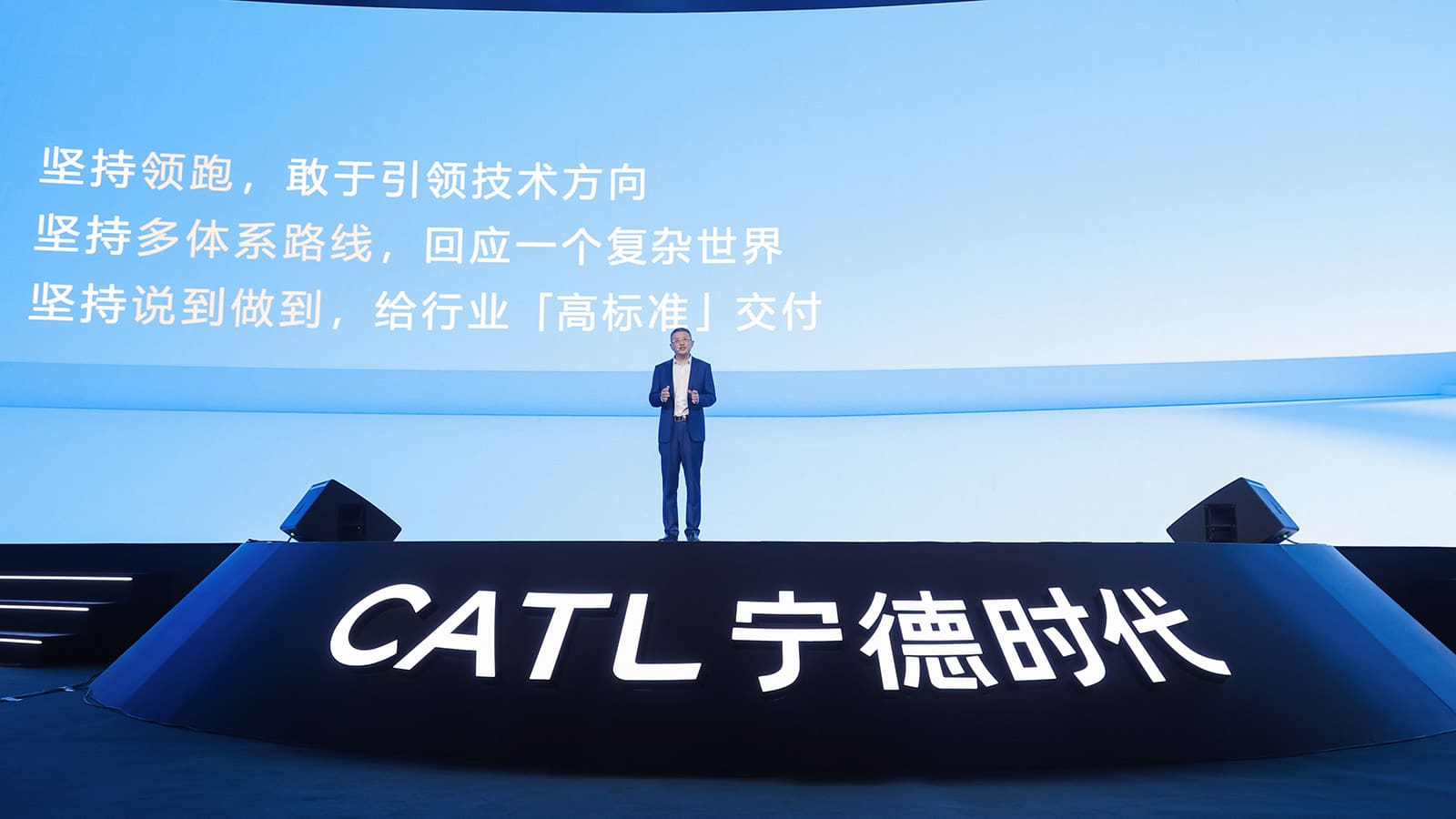
CATL introduced a series of new battery products at its 2026 Tech Day this evening, spanning passenger cars, hybrids, racing applications and battery swapping, as the world’s largest power battery maker moves to reinforce its leadership in an increasingly competitive industry. The event came exactly one year after its previous Tech Day.
CATL officially launched the third-generation Qilin Battery, which supports charging at an equivalent 10C rate and can reach a peak of 15C.
The nickel-cobalt-manganese (NCM) battery achieves a volumetric energy density of 600 Wh/L and a gravimetric energy density of 280 Wh/kg, both among the highest in the industry.
A 125 kWh Qilin Battery pack delivers more than 1,000 km of driving range.
A pack of that capacity weighs only 625 kg — 255 kg lighter than a comparable lithium iron phosphate (LFP) battery.
This brings a noticeable improvement in handling. Vehicles equipped with the new battery accelerate from 0 to 100 km/h 0.6 seconds faster, and braking distance from 100 km/h is reduced by 1.44 meters, according to CATL.
In the moose test, the battery enables a speed 8% higher, reduces body roll by 6.5%, and improves extreme hazard avoidance capability by 15% to 25%.
The lighter weight also cuts energy consumption by more than 6% per 100 km, saving around 0.78 kWh per 100 km, CATL said.
At the same time, the battery extends the service life of vehicle components. The lifespan of key chassis parts is extended by 40%, and tire life improves by over 30%, pushing replacement intervals out by at least 10,000 km.
The battery’s volume shrinks by 112 liters, equivalent to the space of three standard 20-inch suitcases, while passengers gain an extra 18 mm of headroom inside the cabin.
A track version of the Qilin Battery, also launched at the event, supports equivalent 10C charging and delivers peak discharge power of up to 3,000 kW.
CATL also introduced the Qilin Condensed Battery, with a gravimetric energy density of 350 Wh/kg, a volumetric energy density of 760 Wh/L, and a pack weight of under 650 kg.
Executive-class sedans equipped with this battery can achieve a range of 1,500 km, while full-size large SUVs can reach 1,000 km.
CATL also unveiled the third-generation Shenxing superfast charging battery, capable of equivalent 10C charging with a peak of 15C.
The battery can be charged from 10% to 35% in just one minute, and from 10% to 80% in only 3 minutes and 44 seconds. Charging from 10% to 98% takes just 6 minutes and 27 seconds.
Even in extreme cold of –30°C, charging from 20% to 98% takes roughly 9 minutes.
After 1,000 full charging cycles, the battery retains more than 90% capacity, according to CATL.
In March, BYD released its second-generation Blade Battery and flash-charging technology, which can charge from 10% to 70% in 5 minutes and from 10% to 97% in 9 minutes.
Targeting extended-range and plug-in hybrid models, CATL released the second-generation Freevoy Super Hybrid Battery.
The battery provides 500 km of all-electric range and supports equivalent 10C charging, delivering a “charge once a week” experience for range-extended vehicles, CATL said.
Based on LFP chemistry, the battery reaches an energy density of 230 Wh/kg, a 20% improvement over conventional LFP batteries and a 15% gain in range.
CATL also rolled out an NCM version of the Freevoy Super Hybrid Battery, with the same equivalent 10C charging speed. It offers 600 km of all-electric range and a combined range of up to 2,000 km.
Rugged off-road vehicles using the battery can deliver “megawatt-class” power output. Power reaches 1,500 kW at full charge and remains at 1,200 kW even at 20% state of charge.
The system provides more than three times the power required in off-road scenarios that demand over 350 kW of output, the company said.
CATL officially launched the Choco-Swap #26 battery, built on an 800-volt high-voltage architecture. The first product to hit the market will be a 75 kWh version, with larger capacities to follow, covering B-segment and C-segment vehicles.
Together with the earlier #20 and #22 versions, the Choco-Swap battery series now covers the full range of vehicles from A0 to C segments.
The Choco-Swap program has so far partnered with 11 automakers and 18 passenger vehicle brands, covering 25 models.
CATL announced that both the Choco-Swap stations for passenger cars and the Qiji swap stations for heavy-duty trucks will come standard with Shenxing superfast charging piles.
CATL plans to build 4,000 integrated charge-and-swap stations by the end of 2026, covering nearly 190 cities and a nationwide highway network spanning 12 vertical and 11 horizontal corridors. To date, the Choco-Swap network has built 1,470 stations across 99 cities.
CATL plans to build more than 100,000 shared energy replenishment facilities by the end of 2028.
Contact Person: Miss. Kiki
| WhatsApp : | +8617763224709 |
|---|---|
| Skype : | +8617763224709 |
| WeChat : | +8617763224709 |
| Email : | kiki@lifepo4-battery.com |
